How to Choose a Stepper Drive?
There are four key factors to consider when selecting a stepper drive:
voltage,
current,
microstepping, and
maximum step pulse rate.
When choosing a drive, ensure that it can handle a wide range of currents. This allows the system to be tested under different voltage levels to meet various application requirements. The output current of the drive should be
no less than 1.4 times the rated current of the motor. Select a drive with multi-step resolution to test different microstep settings for the smoothest motion performance. Finally, make sure the drive can receive sufficient step pulses to enable the motor to rotate at the desired speed. Sometimes, drives are limited to a narrow range of 10kHz. For example, if you intend to use an 1.8° stepper motor with 8x microstepping, the maximum rotation speed will be calculated as:
10000 / (8 × 200) = 6.25 rps.
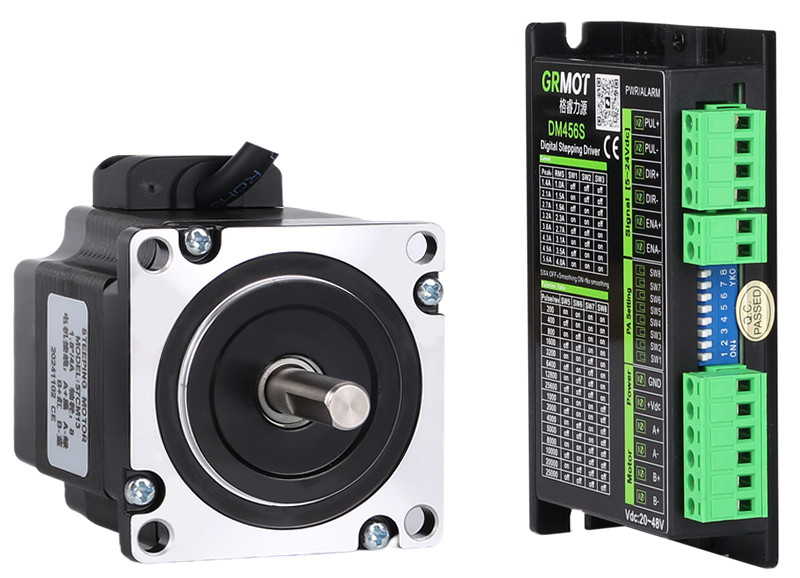
Microstepping can improve system resolution, thereby achieving smooth rotation and reducing vibration and noise. Problems will arise if an incorrect voltage is applied to a
PWM (Pulse Width Modulation) or chopper drive. We have received numerous inquiries about these drives: for instance, if a motor has a rated voltage of 5V, many users wonder why a higher voltage is required, and why performance does not improve after switching to a PWM/chopper drive.
When working with stepper motors and drives, engineers sometimes overlook basic motor principles such as
back EMF and
electrical time constant. This leads to incorrect configuration of the stepper drive or the motor-drive system, resulting in insufficient power supply (voltage/current) for the application.
Many issues can occur when engineers fail to understand the purpose of microstepping. Its primary goal is to enhance the smoothness and reliability of motor operation by balancing the torque ripple of the stepper motor. Misusing microstepping can significantly reduce the available torque generated by the motor, which often requires selecting a much larger motor than needed for other applications. Those who do not know how to use microstepping properly may opt to abandon it and switch to servo-based systems instead, adding unnecessary complexity and cost. Engineers may also attempt to suppress system vibration through mechanical design modifications. If an inappropriate stepper motor is selected, it will be unable to move the load. Therefore, when choosing a motor, not only the load weight but also the friction characteristics of the mechanism must be taken into account.
Stepper drives offer a cost-effective solution and can be utilized appropriately, provided that the following considerations are noted:
- Does the system require position verification?
- An incorrectly selected stepper drive can cause ringing, resonance, and poor low-speed performance. Therefore, choose the right stepper drive at the time of purchase.
- Stepper motors may produce a humming noise at high speeds. This is because the high pole count of the stepper motor leads to hysteresis and eddy current losses at elevated speeds.
For these reasons,
it is not recommended to operate stepper drives continuously at speeds exceeding 2000 revolutions per minute (rpm). Finally, since full current is required to generate holding torque, stepper motors will become hot when stationary.
For advice on how to configure a suitable stepper drive, please consult the engineers at
GRMOT (Shenzhen Gerui IoT Technology Co., Ltd.).


 Company Profile